
Introduction
Why context switching is the enemy, and how hun defeats it.
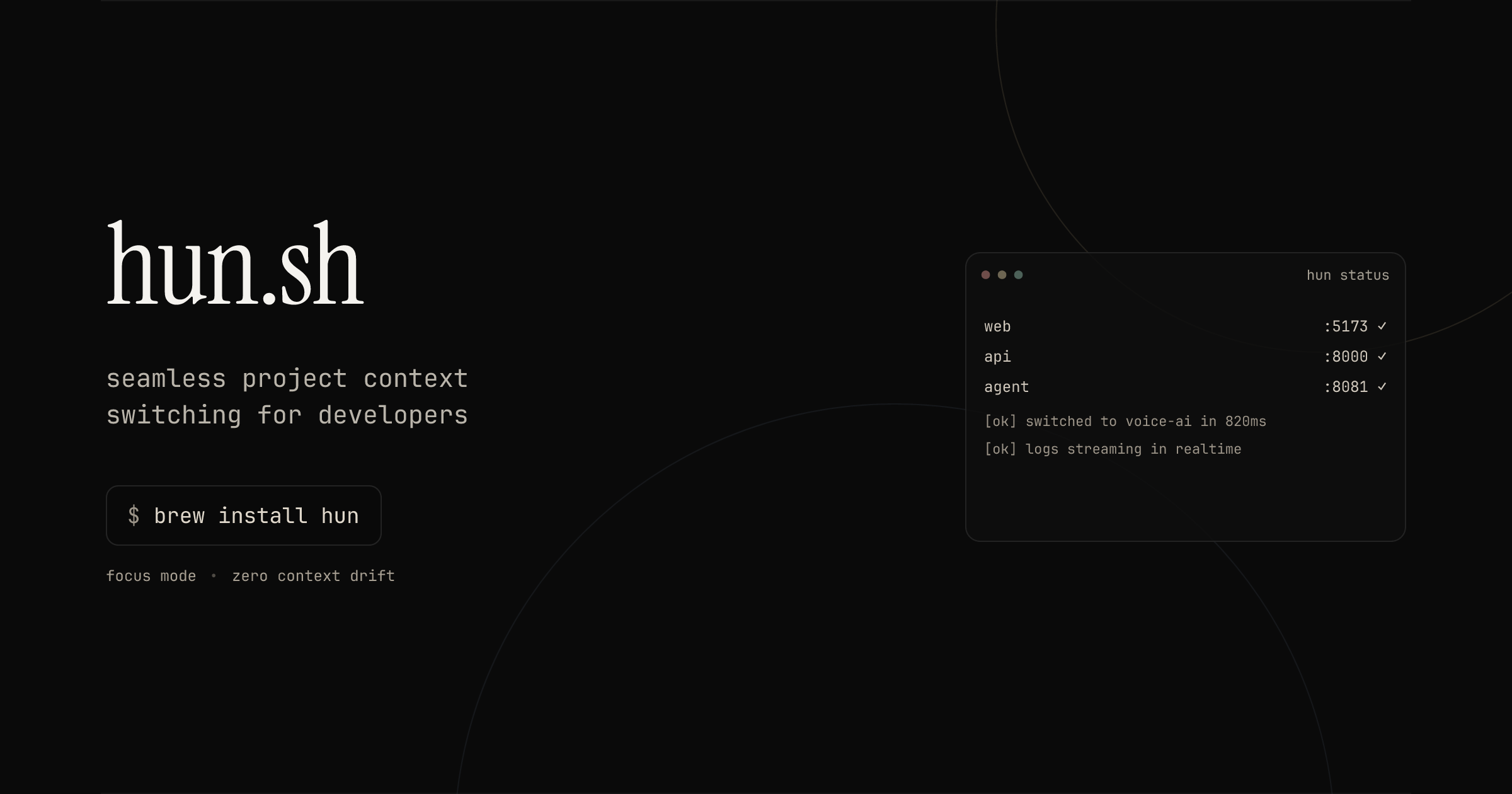
Welcome to hun.
If you are a developer in 2026, your brain is probably doing way more work than it should.
You are working on Project A. A notification pops up. You need to fix a critical bug in Project B.
So you:
- Stop the dev server for
Project A. - Stop the database container.
- Maybe kill a Redis instance you forgot about.
- Navigate to
Project B. - Start the database.
- Start the backend.
- Start the frontend.
- Waiter... where is the log for the backend?
By the time you are ready to write code, you have lost your flow. The "context switch" tax is real, and you pay it every single day.
The "Project First" Philosophy
hun changes the unit of operation from "process" to "project".
It doesn't just run commands. It understands that your backend, frontend, database, and message queue are all part of one thing. When you want to work on that thing, you shouldn't have to assemble it manually every time.
With hun:
- Global Command Center. Run
hunfrom anywhere to manage all your projects. - Switching is instant. Press
p, pick a project, and the environment spins up instantly. - The TUI is King. A lightning-fast dashboard for all your running services. No more alt-tabbing between 5 terminal windows.
- Logs are civilized. Logs are captured, categorized, and queryable from a unified interface.
- Ports are managed. Need to run two projects at once? hun can auto-offset ports so they don't collide.
It's Not Magic, It's specific
Under the hood, hun is a lightweight daemon that manages child processes. It's not a heavy container orchestrator like Kubernetes. It's not a generic terminal multiplexer like tmux.
It is a tool built specifically for the local development lifecycle. It sits right between your terminal and your code, handling the boring stuff so you can stay in the zone.
Ready to stop fighting your terminal?
Let's get you set up.